
Local SEO · Google Business Profile · Tradies
Local SEO for Tradies: A Complete Guide to Getting Found Online
Executive Summary
Key takeaways, what you'll get from this guide
- Why local SEO is worth more than any paid ad you're running, and how to prove it with numbers
- The Google Maps 3-pack: exactly what determines who gets in and what you can do about it
- On-page SEO for tradies: title tags, schema markup, Core Web Vitals, and suburb targeting, done properly
- Your licence number is an SEO signal, how to use it legally and competitively
- How 2026's AI search (ChatGPT, Perplexity, Google AI Overviews) is changing how tradies get found, and how to be included
Local SEO is the practice of optimising your online presence so that your trade business appears prominently when someone in your area searches for your services, whether on Google, Apple Maps, Bing, or increasingly through AI assistants like Siri, ChatGPT, and Google AI Overviews.
Most tradies already have a Google Business Profile and a website. Very few have them set up in a way that actually drives inbound work. The gap between "present online" and "ranking for the right searches" is where your competitors are quietly taking every inbound job in your suburb. If you would rather have the whole lot done for you, see our SEO for tradies service.
A few numbers that put this into context:
97% of consumers search online for local businesses, with the majority of that search happening on mobile 1.
42% of people searching a local term click a result in the Google Local 3-pack, the top three map listings 2.
76% of people who search for a local service on mobile visit a business within 24 hours 3.
Tradies with complete, optimised Google Business Profiles receive 7× more website visits than those with incomplete listings 4.
This guide walks through every layer of local SEO, from the foundation to the 2026 edge cases, with everything adapted specifically to Australian trade businesses.
Why Does Local SEO Matter More Than Paid Ads for Tradies?

Most tradies start with Google Ads or hipages when they want more work. The logic makes sense, you pay, you get leads. But local SEO compounds in a way paid ads never do.
When you stop paying for Google Ads, the calls stop the same day. When you build local SEO properly, the rankings and reputation stay. A page that ranks #1 for "plumber Parramatta" will still be generating calls in three years. The Google Ad you ran last Tuesday won't.
There's also a trust signal difference. When someone calls you from a paid Google Ad, they don't know you're paying to appear there. When you appear at the top of the organic map results with 40+ reviews, a complete profile, and photos of local jobs, you look like the obvious choice, not a business that bought their way to the top.
The ROI case is straightforward. Consider a tradie who books 5 additional jobs per month from local SEO improvements, at an average job value of $800, that's $4,000 extra revenue per month, or $48,000 per year. The monthly investment in a well-managed SEO presence is typically $300–$800 for professional help, or 5–10 hours of your own time.
The rule: Local SEO builds an asset. Paid ads rent attention. Both have a place, but local SEO is the foundation.
How Do I Get Into the Google Maps 3-Pack?
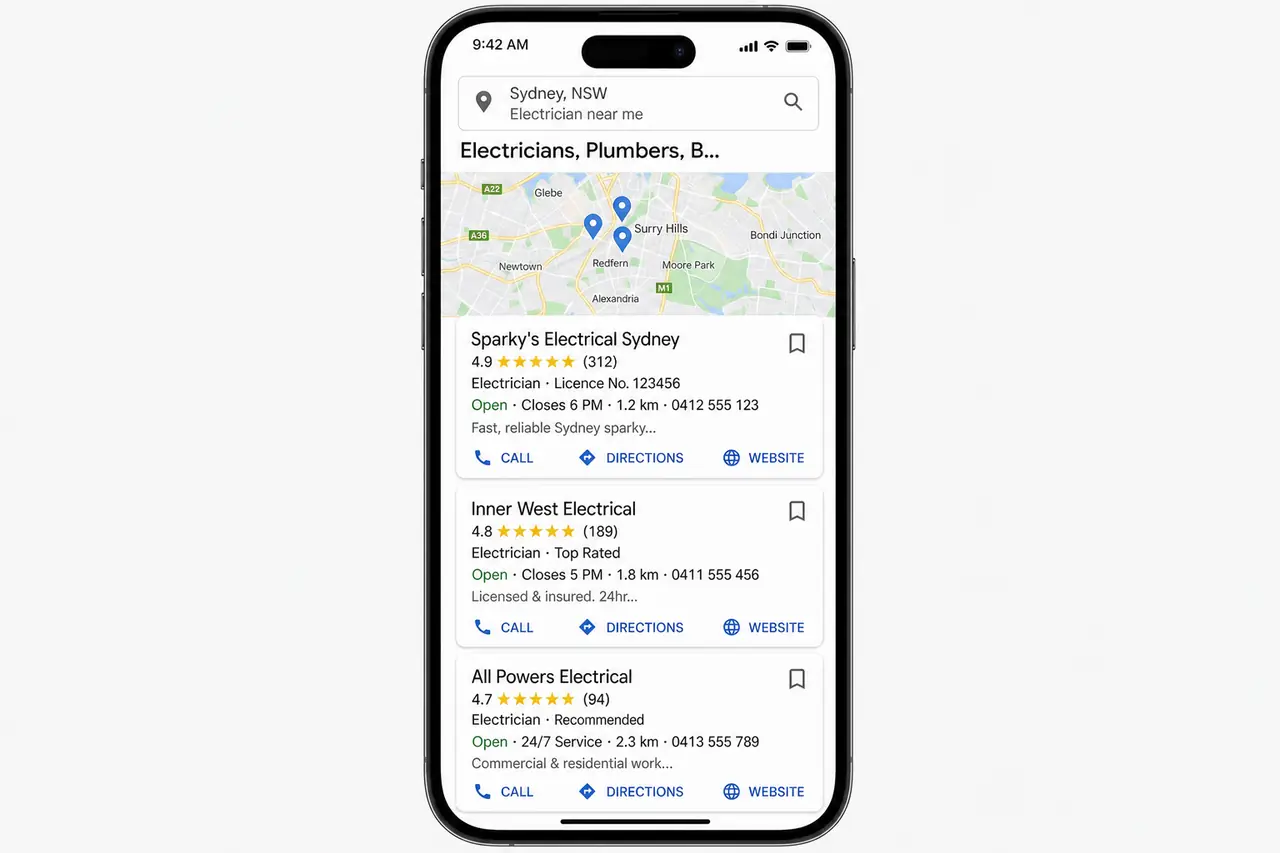
The Google Maps 3-pack, the box showing three local businesses at the top of Google search results, is the most valuable real estate in local search. Of people searching a local term, 42% click one of those three 2.
Here's what Google uses to decide who gets in:
Relevance
Does your listing match what the customer searched for? Google looks at your business category, the keywords in your Google Business Profile description, and the services you've listed. A plumber listing only "plumbing" as a service will lose to one who has also listed "emergency leak repair", "blocked drains", "hot water systems", and "bathroom renovation" separately.
Distance
How close is your listed address or service area to where the searcher is located? This is partly why service area businesses need to be thoughtful about which suburbs they claim. Spreading too wide dilutes your relevance for the suburbs you actually work in most.
Prominence
How well-known is your business online? Google measures this through the number and quality of your reviews, the strength of your Google Business Profile, your website's domain authority, and your citation consistency across the web.
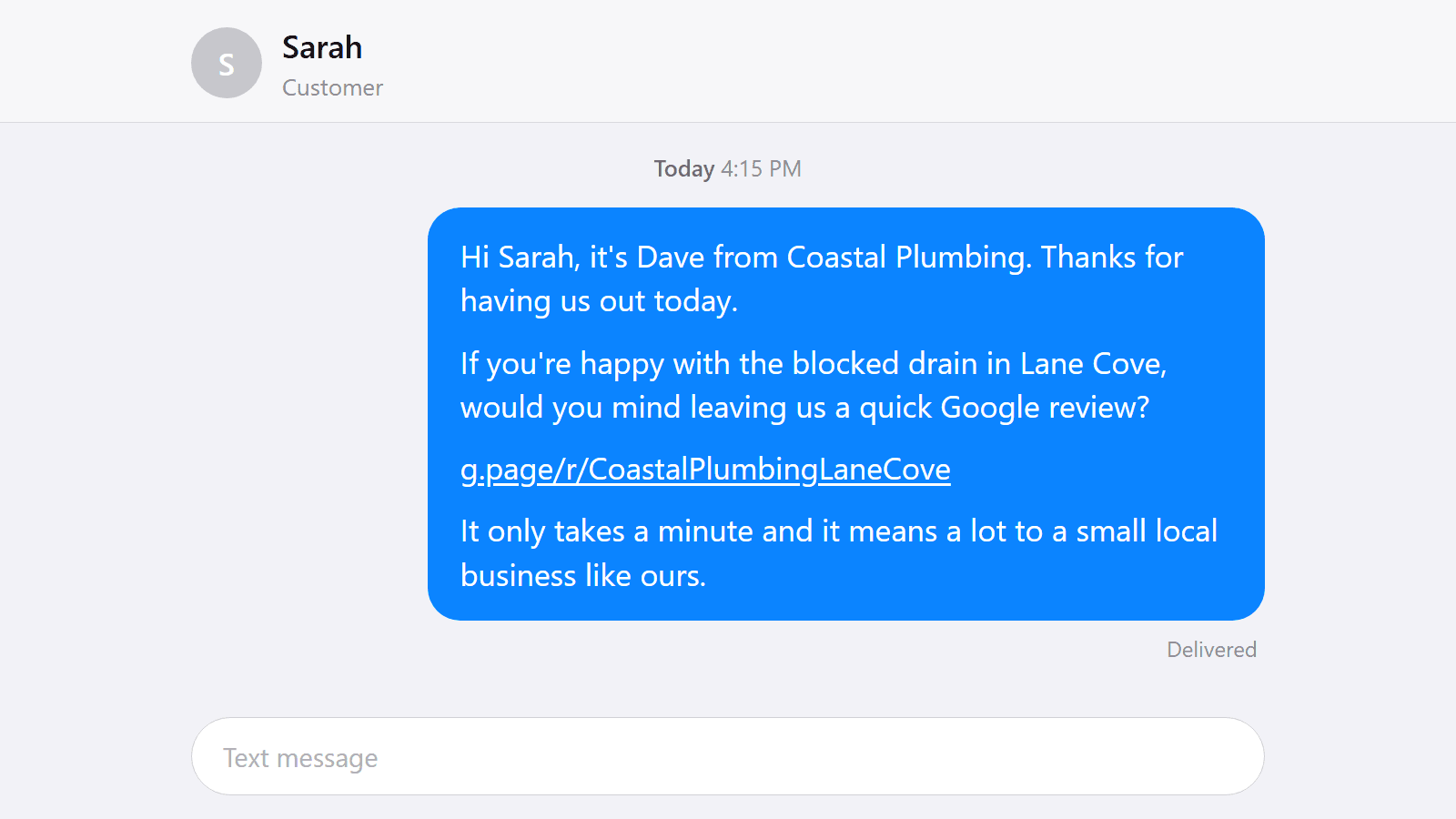
The single highest-impact action to improve your 3-pack ranking: get consistent 5-star reviews from jobs in specific suburbs, with those suburb names mentioned in the review text. Google ties review geography to ranking for those areas. A review that says "I had Steve out to fix a blocked drain in Terrigal, brilliant job" does more for your Terrigal ranking than a generic five-star review.
See our full guide on how to get and manage Google reviews as a tradie.
Your Google Business Profile, the foundation
Everything else in local SEO builds on top of your Google Business Profile. Before optimising anything else:
- Verify your listing if you haven't already
- Set up as a Service Area Business (don't display your home address)
- Add every relevant service as a separate line item under Services
- Upload 10+ photos including before-and-afters from local jobs
- Include your trade licence number in your description
- Set your hours correctly, including emergency callout availability
Full setup guide: The Ultimate Google Business Profile Guide for Australian Tradies.
Why Is Your Licence Number an SEO Signal?
This surprises most tradies. Your trade licence number isn't just a legal compliance item, it's an SEO trust signal.
In most Australian states, displaying your licence number when advertising your services is a legal requirement. A directory listing, a Google Business Profile description, a website footer, all count as advertising. The QBCC, NSW Fair Trading, Consumer Affairs Victoria, and equivalent bodies in other states all have the same requirement.
Here's the SEO angle: Google's Quality Evaluator Guidelines specifically prioritise E-E-A-T, Experience, Expertise, Authoritativeness, and Trustworthiness, for service businesses. A tradie who displays a verifiable licence number scores higher on Trustworthiness. When a search crawler sees your licence number in your GBP description, your website, and your directory listings, consistently, it's a signal that your business is legitimate and compliant.
Practical action: Include your full licence number in:
- Your Google Business Profile description
- Your website footer (on every page)
- Every directory listing you create
- Your email signature
Use the format your state licencing body uses, for example: QBCC Licence No. 1234567 or NSW Contractor Licence No. 123456.
What On-Page SEO Should a Tradie's Website Have?
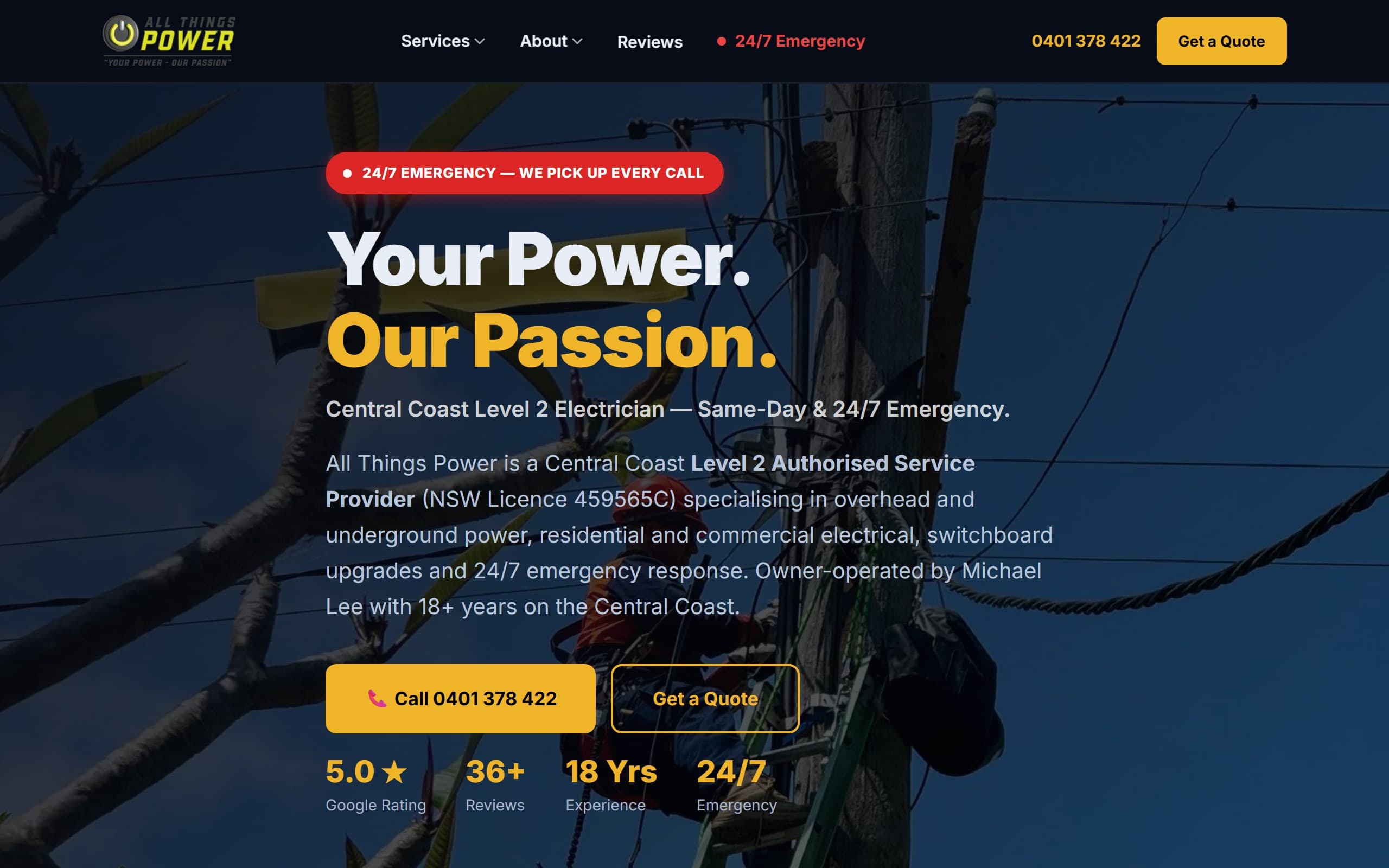
Your website is the second pillar of local SEO after your Google Business Profile. Google uses your website to verify and expand on what your GBP says, so they need to be consistent and reinforce each other.
Location-specific title tags and meta descriptions
The <title> tag is one of the strongest on-page ranking signals Google reads. For tradies, every page should include the trade and the location.
Homepage title tag examples:
Penrith Plumber | Emergency & Residential Plumbing | ABC PlumbingElectrician Newcastle | Licensed & Insured | Smith Electrical
Service page title tag examples:
Hot Water System Repairs, Plumber in Gosford | ABC PlumbingSwitchboard Upgrades Newcastle | Smith Electrical
Meta descriptions don't directly affect ranking but do affect click-through rate. Write them for the customer, not the crawler:
"Newcastle's most reviewed electrical contractor. Licensed switchboard upgrades, fault finding, and new installations. Call today for a same-day quote."
NAP consistency on-page
Your business Name, Address (or service area), and Phone number must appear on your website in a text format that Google can read (not an image). The most important place is your footer, it appears on every page. It must match exactly what's in your Google Business Profile and every directory listing. "St" vs "Street" actually matters.
Schema markup, the structured data layer
Schema markup is code added to your page that tells Google structured facts about your business. Google uses it to understand the page, and it can make the page eligible for rich results, the search listings with extra features 5, though Google doesn't guarantee them 6.
For a tradie's website, these schemas are most valuable:
LocalBusiness schema (most important)
{
  "@type": "Plumber",
  "name": "ABC Plumbing",
  "address": {
    "@type": "PostalAddress",
    "streetAddress": "12 Example Street",
    "addressLocality": "Penrith",
    "addressRegion": "NSW",
    "postalCode": "2750",
    "addressCountry": "AU"
  },
  "telephone": "02 1234 5678",
  "areaServed": ["Penrith", "Blacktown", "Hills District"],
  "priceRange": "$$",
  "hasCredential": {
    "@type": "EducationalOccupationalCredential",
    "credentialCategory": "licence",
    "name": "NSW Contractor Licence No. 123456"
  }
}
The @type should be your specific trade: Plumber, Electrician, GeneralContractor, HVACBusiness, RoofingContractor, Painter. Google lists name and address as the only required properties, so always include both 6.
FAQPage schema, if a page has a real FAQ section, you can still mark it up, but it won't change how that page looks in Google search results. Google stopped showing FAQ rich results from 7 May 2026. Only mark up the questions and answers people can actually see on that page.
Review schema, skip it for your own testimonials. Google's rules say a business's reviews of itself, shown on its own website, aren't eligible for review stars, and that includes reviews shown through an embedded Google reviews widget 7. Keep showing testimonials on your site for the people reading it. Your star rating in Google comes from your Google listing, where it shows in Maps and Search 8.
Our websites come with schema pre-configured. If you're on a DIY platform, the Made 4 Tradies free website audit checks whether your schema is present and correctly implemented.
Mobile-first and Core Web Vitals
Google ranks the mobile version of your site. If your website is slow, hard to use on a phone, or requires pinch-to-zoom, you're being penalised in rankings and losing customers who bounce immediately.
Core Web Vitals are Google's official page experience metrics:
| Metric | What It Measures | Target |
|---|---|---|
| Largest Contentful Paint (LCP) | How fast the main content loads | Under 2.5 seconds |
| Interaction to Next Paint (INP) | How fast the page responds to taps | Under 200ms |
| Cumulative Layout Shift (CLS) | Whether content jumps around while loading | Under 0.1 |
For tradies, the most common Core Web Vitals failures are:
- Oversized hero images, compress everything below 200KB before uploading
- Render-blocking fonts, use
font-display: swapon custom fonts - No lazy loading on images, add
loading="lazy"to anything below the fold - Unoptimised WordPress themes, a lightweight theme (GeneratePress, Kadence) beats a feature-heavy one every time
You can check your site's Core Web Vitals for free using PageSpeed Insights, just enter your URL.
Internal linking
Internal links help Google understand which pages on your site are most important and how they relate to each other. For a tradie's site:
- Your homepage should link to every major service page
- Every service page should link back to your homepage and to related services
- Blog posts should link to your most relevant service pages
The anchor text matters. "Click here" tells Google nothing. "Hot water system repairs in Gosford" tells Google exactly what the destination page is about.
Service Pages vs Suburb Pages: Which Should You Build First?
Short answer: service pages first, suburb pages second. Most tradies who want to rank properly need both, not one or the other.
This is one of the most common questions we get after a site goes live. An SEO bloke sells 30 suburb pages. Your mate says you only need one homepage. Here is the plain-English version.
What each type of page is for
Service pages catch what people need:
- "blocked drain plumber"
- "switchboard upgrade electrician"
- "hot water replacement"
Someone has a problem. They search by job type. One generic "Services" page rarely ranks for any of those. A dedicated page for each job you actually quote tells Google and the customer what you do.
Suburb pages catch where you work:
- "plumber Penrith"
- "electrician Lane Cove"
Those are location searches. A homepage that says "we service all of Sydney" does not compete with a page built for one suburb, backed by reviews and jobs from that area.
Which comes first?
| Your situation | Build this first |
|---|---|
| One main area, a few job types | Service pages on a solid homepage |
| Multi-service tradie (drains, hot water, gas, etc.) | Service pages before suburbs |
| Multi-area tradie covering 5–15 suburbs | Service pages, then 5–10 genuine suburb pages |
| Single suburb, referral-heavy | Strong homepage + Google listing may be enough for a while |
The order that works for most tradies:
- Complete Google listing + mobile site with click-to-call
- A page per service you want Google to send (start with your top 3–5 job types)
- Suburb pages for areas you genuinely work in (start with five where you already have jobs and reviews)
Why not suburbs only?
Copy-paste suburb pages ("Plumber in [Suburb]" with the name swapped) are a common SEO sell. Google treats thin duplicates as doorway spam. Suburb pages only work when each one has real local detail, links to your service pages, and matches your Google listing service area. Full build guide: suburb pages for tradies.
Why not services only?
If you cover ten suburbs and only have service pages, you can rank for "hot water installation" broadly but struggle for "hot water installation Parramatta". In the map pack, suburb signals matter: reviews mentioning areas, listing service area, local content on the site.
Do you need a page for every service × every suburb?
Usually no. That is a large-operator play. For most Australian tradies, dedicated service pages plus 5–10 quality suburb pages beats a grid of 50 thin combinations.
Neither replaces the other. Service pages answer "can you do this job?" Suburb pages answer "do you work here?" For how long each layer takes once you start building, see how long SEO actually takes for a tradie.
Made 4 Tradies Max Multi-Page is built around service pages. Pro Multi-Page (the live price) adds 10 suburb landing pages on top because multi-area tradies need both layers, not suburbs alone.
How Do I Target Specific Suburbs With Local SEO?
This is one of the most powerful and underused strategies for tradies operating across a large service area. Ranking for "plumber Sydney" is almost impossible. Ranking for "plumber Penrith" is very achievable, and that's where the customers you can actually serve are.
Suburb landing pages
A suburb landing page is a dedicated page on your website targeting one specific location you service. Done properly, it is not a template with the suburb name swapped in. For the full build guide (checklist, thin-content traps, how many pages to create), see Suburb Pages: Why Tradies Need Them and How to Build Them.
A good suburb page includes:
- The trade + suburb in the title tag, H1, and first paragraph
- Your licence number (legal requirement)
- 2–3 sentences about the specific area ("We cover all of Penrith including South Penrith, Kingswood, and Glenmore Park")
- Local social proof, if you have a job or review from that suburb, mention it
- Your phone number prominently
- A contact form or click-to-call button
What to avoid: Thin suburb pages with no unique content. Google can detect copy-pasted templates with just the suburb name changed. If you have 30 identical suburb pages, they'll all rank poorly or be ignored entirely.
Service area in Google Business Profile
List your specific suburbs in the Service Area section of your GBP, not just "Greater Sydney" or "Central Coast". List the individual suburb names. This directly influences which local searches you appear in.
A good target: 15–25 specific suburbs. Too few and you're underselling your coverage. Too many and Google may not trust that you can genuinely serve them all.
Suburb-specific content in blog posts
When you write about a topic, mention specific suburbs where you've done that work. "We recently installed a solar hot water system in Wyong" or "A homeowner in Erina called us about a leaking pipe under the house", these signals tell Google which areas you're active in, without needing a dedicated suburb page for every single location.
How Does Voice Search Affect a Tradie's Local SEO?
Voice search is now how a significant portion of local service searches begin. When someone asks Siri "find me a plumber near me open now" or tells Google Assistant "electrician in Gosford", the results come directly from Google Business Profile listings.
The implications:
Voice searches are longer and more conversational. Someone typing searches for "plumber Penrith". Someone speaking searches for "who is the best plumber in Penrith that's available on weekends". Your website content and GBP description should include natural language phrases that match how people speak, not just how they type.
"Near me" searches go to the nearest accurate listing. If your GBP service area or address is incorrect, you won't appear for "near me" queries even when you're geographically the closest option.
Siri pulls from Apple Maps. Set up Apple Business Connect, it's free and critical for iPhone users who make up roughly half the Australian smartphone market. Guide to listing on Apple Maps and other directories →
Practical additions for voice search:
- Add your trading hours to your GBP and keep them accurate, "open now" is a common voice search qualifier
- Include natural language phrases in your GBP description: "Available for emergency callouts", "Same-day quotes available"
- Answer common spoken questions directly on your website: "How much does a hot water system replacement cost in Penrith?"
How Does AI Search (ChatGPT, Perplexity, Google AI Overviews) Affect Tradies?
This is the 2026 angle that most local SEO guides haven't caught up to yet.
AI-powered search tools, Google AI Overviews, ChatGPT Search, Perplexity, now answer many local service questions directly, without the user clicking through to a website. When someone asks "what should I look for in a good electrician in Newcastle?", an AI Overview or Perplexity answer might surface. The businesses and information that get cited in those answers are the ones that have structured, authoritative, easily-parseable content.
What this means for your trade business:
Google says you don't need anything special to appear in AI Overviews or AI Mode: no special markup and no AI files. A page has to be indexed and able to show in normal Google results, and the usual basics still count, including keeping your Google listing up to date 9. The same SEO basics that help you in normal local search apply to AI Overviews too 9.
ChatGPT Search finds websites with OpenAI's search crawler, OAI-SearchBot, and OpenAI says a site that blocks it won't be shown in ChatGPT search answers 10.
Perplexity uses its own crawler, PerplexityBot, to find and link websites in its search results 11. So check your website isn't blocking either crawler.
All Made 4 Tradies websites let both crawlers in. They also include a .md copy of every page and an llms.txt file, but Google says you don't need AI text files or Markdown copies to appear in Google Search, so treat those two as extras aimed at other AI tools, not an edge in Google 12.
The practical action for tradies: Answer the questions your customers actually ask, clearly and in your own words, on your main service pages. Google's advice for its AI search is to write useful, original content for the people you serve, not to reshape pages for AI 12. A short FAQ section covering real questions about [your trade] in [your area] is an easy way to do that.
What Is NAP Consistency and Why Does It Keep Coming Up?
NAP stands for Name, Address, Phone number. Every time your business appears online, whether on your Google Business Profile, Yellow Pages, Yelp, or a local community website, that's a citation.
Consistent citations tell Google that your business is legitimate, stable, and where it says it is. Inconsistent citations, even minor variations like "Pty Ltd" vs "Pty. Ltd." or "0412 123 456" vs "0412-123-456", create contradictory signals that can quietly suppress your local rankings.
The most common NAP inconsistencies tradies don't notice:
- Business name formatted differently across platforms (trading name vs registered name vs ABN name)
- Mobile number on some listings, landline on others
- Old address from before you moved service areas
- Suburb listed as part of the address on some platforms but not others
For Australian tradies, NAP should also include your trade licence number as a consistent fourth element across all platforms.
Run a citation audit, search your business name in Google and check the first 10 results. Compare what appears with what's on your GBP. Anywhere they differ is a citation you need to fix.
What Is a Monthly Local SEO Checklist for Tradies?
Local SEO isn't set-and-forget. Here's what to do each month:
Week 1, Google Business Profile
- Check that your hours, phone number, and service area are still accurate
- Respond to any unanswered reviews (positive and negative)
- Add at least one new photo, a job photo from that week works perfectly
- Post one GBP update: a completed job, a seasonal tip, or a service highlight
Week 2, Reviews
- Follow up with customers from the previous fortnight and ask for a review
- Check for any new reviews on Yellow Pages, Yelp, WOMO, or hipages and respond
- Flag any suspicious reviews for removal if they violate Google's policy
Week 3, Website
- Check your homepage and key service pages load fast on mobile (use PageSpeed Insights)
- Confirm your contact details and licence number are still correctly displayed
- Add a blog post or FAQ update if you have something useful to share
- Check that internal links to your most important pages are present
Week 4, Citations and directories
- Pick one directory you're not listed on yet and add your listing
- Search your business name and check for any new inconsistent NAP information to correct
- Check that your service area on your GBP still reflects where you're actually working
Is Local SEO Worth Doing Myself or Should I Pay Someone?
The honest answer depends on how much time you have and how fast you want results.
DIY local SEO is realistic if you're willing to spend 5–10 hours per month consistently. The free tools are good, Google Search Console shows you which searches you're appearing for, Google Business Profile gives you performance data, and PageSpeed Insights shows you what's slowing your site down.
Where DIY falls short: Technical SEO (schema markup, Core Web Vitals fixes, server-side rendering), suburb page creation at scale, and citation building across 20+ directories. These are time-intensive and require some technical knowledge to do properly.
The rough cost of professional local SEO for a trade business in a competitive Australian market:
| Tier | What's included | Monthly cost |
|---|---|---|
| Basic | GBP management + reviews + citation building | $300–$500 |
| Growth | Above + on-page SEO + suburb pages + reporting | $600–$1,200 |
| Full-service | Above + content, schema, technical SEO, AI optimisation | $1,200–$2,500 |
The break-even calculation: if local SEO brings you one additional booked job per month and your average job is worth $600, you're already ahead at the Basic tier. Most properly run local SEO campaigns for tradies generate 3–8 additional enquiries per month within 3 months.
How Does a Made 4 Tradies Website Handle Local SEO?
If you're building a new website or wondering whether your current one is holding your SEO back, here's exactly what every Made 4 Tradies website includes, and why it matters.
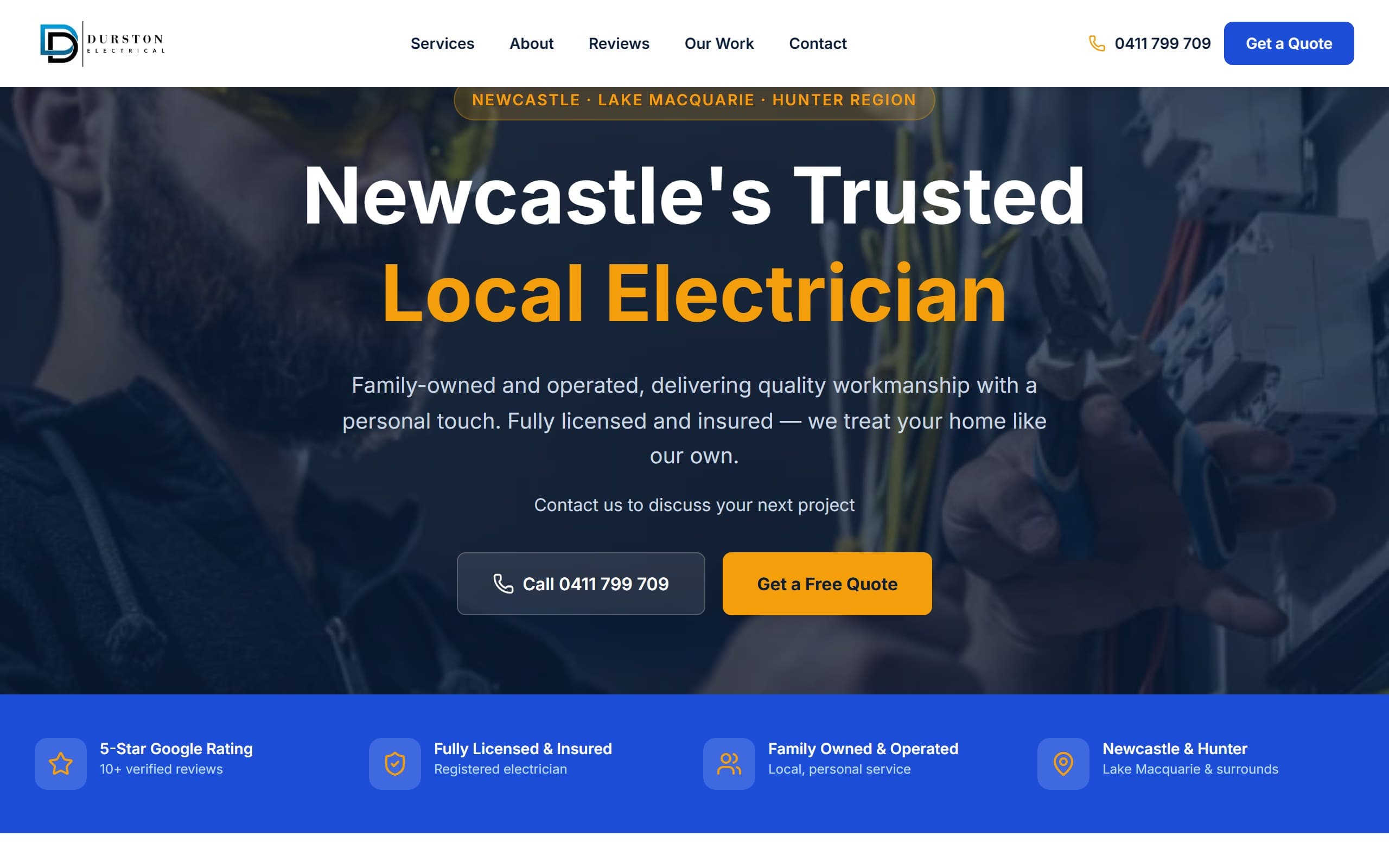
Every Made 4 Tradies website is built with local SEO as the foundation, not an afterthought. That means you're not paying for a website and then separately paying for someone to "SEO-ify" it later, it comes built in.
On-page SEO, built in from day one
Every Made 4 Tradies website ships with:
- Location-specific title tags and meta descriptions on every page, your trade and suburb are baked in, not added as an afterthought
- LocalBusiness schema markup with your trade type (
Plumber,Electrician,GeneralContractor), service areas and your licence number in ahasCredentialfield - FAQPage schema on key service pages, marking up the questions and answers shown in each page's FAQ section
- Your NAP displayed in text (not an image) in the footer of every page, so every page is a citation, not just your contact page
- Mobile-first responsive design that passes Google's Core Web Vitals thresholds for LCP, INP, and CLS from the day it goes live
AI search ready, not a future upgrade
All Made 4 Tradies websites serve:
- A
.mdcopy of every page atyourdomain.com.au/page.md - A dynamic
llms.txtfile at your domain root, listing your business and your pages - Open robots.txt policy for the major AI crawlers, OAI-SearchBot, PerplexityBot, GPTBot, ClaudeBot and Google-Extended are all allowed
These aren't optional add-ons, they ship with every site. The open robots.txt matters most: OpenAI says a site that blocks its search crawler won't be shown in ChatGPT search answers. The .md copies and llms.txt are extras aimed at other AI tools, and Google says you don't need either to appear in Google Search.
Suburb pages, structured for scale
Your site includes suburb-specific service pages with genuine local content, not thin clones with just the suburb name swapped. Each page:
- Includes your trade + suburb in the title tag, H1, and intro paragraph
- Displays your licence number (legal compliance)
- Links to your relevant service pages and contact form
- Is internally linked from your homepage and service index
Built for your content to compound
The blog and resource section is structured to support AI-readable content out of the box.
The result: a website that does its job quietly in the background, generating calls from local searches while you're on the tools. Plumbers: see our dedicated hub →. See what we build →, check our pricing →, or read how much a tradie website should cost in 2026 →.
Want to Know How Your SEO Stacks Up Right Now?
Made 4 Tradies offers a free, no-obligation website audit that checks every layer of your local SEO, on-page signals, Core Web Vitals, schema markup, NAP consistency, and how your site supports your Google Business Profile.
- Free website audit, SEO, speed, schema, local signals, licence number visibility, conversion blockers. PDF delivered in 24 hours.
- Free Google listing audit, Maps ranking, 3-pack factors, review profile, competitive benchmarking. PDF in 24 hours.
No call. No pitch. Just a clear read on what's working and what's costing you work.
Frequently Asked Questions
What is local SEO for tradies?
Local SEO is the process of optimising your online presence so your trade business appears in Google search results when people in your service area search for your services. It covers your Google Business Profile, your website, your directory listings, and your reviews, all working together to put you in front of customers at the moment they need a tradie.
How long does it take to see results from local SEO?
For Google Business Profile improvements (adding services, photos, responses), you can see changes in search appearance within 2–4 weeks. Meaningful ranking improvements for competitive suburbs typically take 3–6+ months of consistent effort across your listing, website, reviews, and area pages. SEO compounds over time, month six is usually stronger than month two if you keep at it. For a full channel-by-channel breakdown and a first 30/90 day checklist, see how long SEO actually takes for a tradie.
What's more important, my Google Business Profile or my website?
Both matter, and they reinforce each other. Your Google Business Profile drives map results and calls. Your website handles clicks, gives Google more signals about your business, and is where AI crawlers verify your claims. A strong GBP with a weak website limits your ceiling. A great website with a neglected GBP means you're invisible in map results. Build both.
Do I need suburb-specific pages on my website?
If you service multiple suburbs and want to rank for searches in each of them, yes. A single homepage targeting "plumber Sydney" will struggle. Individual pages for "plumber Penrith", "plumber Blacktown", and "plumber Parramatta", each with genuine local content, will rank far better for those specific searches. See Service Pages vs Suburb Pages earlier in this guide for build order.
Should I build service pages or suburb pages first?
Service pages first in almost every case. People search by job type before they narrow by suburb. Suburb pages come next when you genuinely cover multiple areas. Suburbs-only sites with thin copy fail. Service-only sites struggle in competitive multi-suburb markets. Full decision table and build order are in Service Pages vs Suburb Pages above.
Does my trade licence number help with SEO?
Yes, in two ways. First, displaying it is a legal requirement in most Australian states when advertising your services, so every listing where it's absent is a compliance risk. Second, Google's quality guidelines reward Trustworthiness, a verifiable licence number is a concrete trust signal. Include it on your GBP, your website footer, and every directory listing.
How does Google decide which three businesses show in the Maps 3-pack?
Google uses three main factors: Relevance (does your listing match the search?), Distance (how close are you to the searcher?), and Prominence (how well-known and trusted is your business online?). Prominence is primarily influenced by review quantity and quality, GBP completeness, website authority, and citation consistency. Of these, review volume in specific suburbs is typically the fastest lever to pull. For a step-by-step tradie habit plan (not just theory), see how to get into Google Maps top 3 for tradies.
What changed with local SEO in 2025–2026?
Two major shifts. First, Google tightened its handling of fake reviews and introduced video verification for some new business listings. Second, AI-powered search (Google AI Overviews, Perplexity, ChatGPT Search) is now surfacing local business information in conversational AI answers. Google says there's no special markup or AI file needed to appear in its AI answers, so the basics that work in normal local search still apply, including an accurate Google listing and clear, useful pages written for your customers.
Is voice search important for tradies?
Yes, particularly for emergency and same-day searches. "Hey Siri, find me a plumber near me open now" is a real search pattern. Voice results come from Google Business Profile listings (for Google/Android) and Apple Business Connect (for Siri/iOS). Keeping both fully updated and accurate is the most important thing you can do to capture voice searches.
References:
- [1] BrightLocal, Local Consumer Review Survey 2017, US consumers
- [2] Backlinko, How People Use Google Search, map pack click share
- [3] Think with Google, How Mobile Search Connects Consumers to Stores, 2016, US smartphone users
- [4] Google, Complete your Business Profile
- [5] Google Search Central, Intro to How Structured Data Markup Works
- [6] Google Search Central, Local Business (LocalBusiness) Structured Data
- [7] Google Search Central, Review Snippet (Review, AggregateRating) Structured Data
- [8] Google Business Profile Help, Tips to get more reviews
- [9] Google Search Central, AI Features and Your Website
- [10] OpenAI, Overview of OpenAI Crawlers
- [11] Perplexity, Perplexity Crawlers
- [12] Google Search Central, guide to generative AI features on Google Search
Published by Made 4 Tradies, built by online experts who understand tradies. Serving Sydney, the Central Coast, Newcastle, and the Hunter.
Free Website Audit
See exactly what your website is costing you.
Send us your web address and a real person checks the lot: how fast it loads on a phone, whether you turn up in local searches, and what is stopping visitors picking up the phone. You get a PDF with specific issues, specific fixes, ranked by impact.
No call. No pitch. No obligation. Turnaround within 24 hours.
Get my free website audit →