
Mobile First · Website Design · Tradies
Why Tradie Websites Need to Be Mobile First
Executive Summary
Key takeaways: what you'll get from this guide
- Why most of your next customers will only ever see your site on a phone
- What "mobile first" really means, and how it is different from "mobile friendly"
- The one-tap call test and why it decides whether a panicked customer rings you or the next tradie
- Why phone load speed on 4G quietly costs you jobs before anyone sees your work
- How Google now ranks your site on the phone version, not the desktop one
- A quick test to check if your own site is built for the phone or just squeezed onto it
A mobile-first tradie website is one designed for the phone screen first, then made to work on a laptop, not the other way around. It loads fast on mobile data, lets a customer call in one tap, and is easy to use one-handed. For a tradie, this is not a nice-to-have. It is where almost every job now starts.
Picture how people actually find you. The hot water system has died. The power point is sparking. Water is coming through the ceiling. They grab the nearest phone, search "emergency plumber near me", and tap the first business that looks real and lets them call straight away. If that is not your site, the job goes to whoever's was.
A few numbers worth knowing:
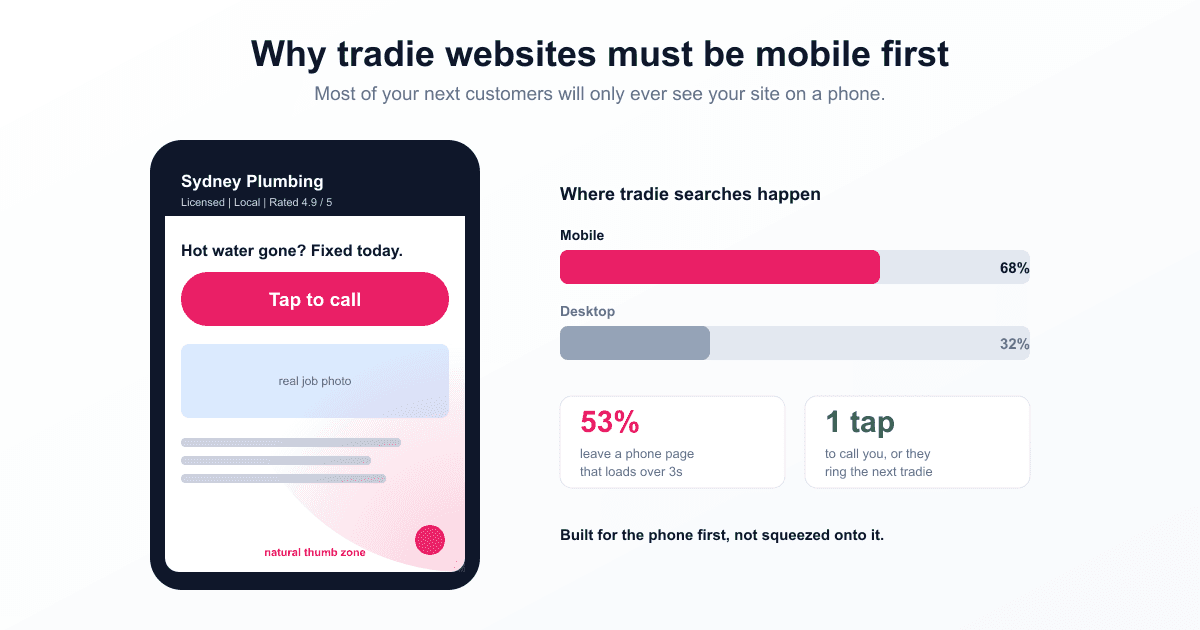
Roughly 68% of local searches in Australia happen on a mobile, so the phone version of your site is the one that matters most 1.
53% of mobile site visits are abandoned if a page takes longer than 3 seconds to load, before they ever see your work or your reviews 2.
Google now uses mobile-first indexing, which means it looks at the phone version of your site to decide how you rank, even for searches done on a computer 3.
More than half of Australians under 35 now use a search engine to find a tradie, and they are doing it on a phone 4.
What Does "Mobile First" Actually Mean?
Mobile first means the site is built for the small screen as the main event, then scaled up for desktop. Most old tradie sites do the opposite. They were designed on a big screen, then "made responsive" so they technically work on a phone. Technically working and actually working are different things.
A mobile-first site has text you can read without pinching, buttons big enough for a thumb, a phone number you can tap, and images that load light and never push the call button off the screen. A desktop-first site shrunk down usually has tiny tap targets, slow heavy images, and a phone number hiding in the footer.
There is a difference between mobile friendly and mobile first. Mobile friendly means your site does not break on a phone. Mobile first means your site is at its best on a phone. Your customers are on phones, so best is what you want.
Action: Open your site on your own phone right now. If your first instinct is to zoom in or turn it sideways, it was not built mobile first.
Why Does This Matter So Much for Tradies Specifically?
Other businesses get browsed. Tradies get called in a hurry. The person searching for you is often mid-problem and stressed, standing in a flooded laundry or a dark kitchen, and they want the fastest path to a real person who can help today.
That changes everything about the site. They are not going to read your story, compare three quotes, or fill out a long form. They will glance, decide if you look legit, and tap to call, all on a phone, often in under a minute. A site built for a relaxed desktop browse misses that moment completely.
This is also why the same site that wins work for a tradie would be wrong for, say, an accountant. Your job is to remove every second of friction between "found you" and "calling you" on a phone.
Action: Think about your last five jobs. How many of those customers found you on a phone, in a hurry? That is who your site is really for.
Does It Pass the One-Tap Call Test on a Phone?
The single most important thing a mobile-first tradie site does is let a customer call in one tap, from the moment the page loads, without scrolling or hunting.
That means a tap-to-call button above the fold, set up as a real tel: link so one tap dials. It means a sticky call bar that follows them down the page, so the option to ring is always there. And it means the number is big and obvious, not tiny grey text someone has to copy out and paste into their dialler.
A customer with water coming through the ceiling is not going to fill in a contact form and wait for an email. Make ringing you the easiest thing on the screen. This one fix moves more work than almost anything else you can do. We cover the full picture in what a good tradie website looks like.
Action: Add a tap-to-call button to the top of your homepage today. It is the highest-value ten-minute job on this list.
Is It Fast on 4G, Not Just on Your Office Wi-Fi?
Speed is where a lot of tradie sites quietly leak work. Your site might feel quick on the wi-fi at home, but your customer is on mobile data in a driveway with two bars. If the page crawls, they are gone before your logo even appears.
More than half of mobile site visits are abandoned when a page takes over three seconds to load 2. The usual culprits are huge unoptimised photos straight off a phone camera, cheap shared hosting, and bloated DIY templates stuffed with plugins. A mobile-first build keeps images light, runs on quick hosting, and loads only what the page needs.
Action: Run your site through Google PageSpeed Insights and read the mobile score, not the desktop one. Under 70 on mobile means you are losing customers to the loading spinner.
Can a Thumb Reach Everything Easily?
Most people use their phone one-handed, with a thumb. A mobile-first site puts the important stuff, especially the call button, where a thumb can reach it without juggling the phone.
That means big tap targets, plenty of space between links so people do not fat-finger the wrong one, and the main action sitting low and central where the thumb naturally lands. Tiny links crammed together, or a call button stuck up in a top corner, force the customer to shuffle their grip. Every bit of fiddle is a chance for them to give up and ring someone else.
Action: Use your site one-handed for two minutes without your other hand. Anything you struggle to tap, your customer struggles with too.
Does It Work on a Cracked Screen, in the Sun, with One Bar?
Your customers are not viewing your site in perfect conditions. They are on a cracked screen, in bright sun, with a dodgy signal, often a bit stressed. A mobile-first site is built to hold up in the real world, not just in a designer's preview.
That means high-contrast text you can read outdoors, forms short enough to finish on a phone (name, suburb, phone, what they need), and a layout that does not fall apart on an older or smaller handset. If your site only looks good on the latest iPhone in a dark room, it is failing most of the people who actually visit it.
Action: Open your site outside, in daylight, on the oldest phone you can find. If it is hard to read or use, that is what some of your customers are seeing.
How Does Google Treat a Mobile-First Site?
This is the part most tradies do not know. Google now uses mobile-first indexing, which means it mainly looks at the phone version of your site to decide where you rank 3. Even when someone searches on a laptop, Google has judged you on your mobile site.
So a clumsy phone experience is not just losing you the customers who land on it. It is also pulling down your ranking, which means fewer customers find you in the first place. A clean, fast, mobile-first site helps you on both fronts: more people see you, and more of them call. The wider ranking picture is in our local SEO guide for tradies.
Action: Search your main service plus your suburb on your phone. If you are not on the first page or in the map pack, a weak mobile site may be part of why.
Mobile First vs Desktop First, Side by Side
Score your own site against this. Most older tradie sites sit firmly in the left column.
| What the customer hits | Desktop-first site on a phone | Mobile-first site |
|---|---|---|
| First impression | Pinch and zoom to read anything | Readable straight away, no fiddling |
| Phone number | Tiny text in the footer | One-tap call button above the fold plus a sticky call bar |
| Load speed on 4G | Slow, heavy images, often 8 seconds plus | A couple of seconds, light images |
| Buttons and links | Tiny, crammed, easy to mis-tap | Big tap targets a thumb can reach |
| Forms | Long, painful to fill on a phone | Short: name, suburb, phone, job |
| In the sun, one-handed | Hard to read and use | Holds up in real conditions |
| Google ranking | Marked down by mobile-first indexing | Helped by a strong mobile site |
| Result | Customer gives up and rings the next tradie | Customer taps and calls you |
How M4T Builds Mobile First
We build every tradie site for the phone first, because that is where your work comes from. One-tap calling above the fold, a sticky call bar, light fast-loading images, big thumb-friendly buttons, short forms, and a layout that holds up on a cracked screen in the sun. Then we make sure it stands up to Google's mobile-first indexing so you rank as well as you convert. We pull the copy and photos from what you already have, so it costs you a couple of hours, not a couple of weekends.
Built for the phone first, for calls and local Google ranking, using your existing photos and details.
Not sure what a good site looks like overall? Start with what a good tradie website looks like, or see live builds in our best tradie website examples teardown.
Explore our dedicated websites for tradies service packages, or see our pricing →
Want Us to Check Yours on a Phone and Tell You Straight?
The quickest way to know if your site is genuinely mobile first is to have someone who builds these every day open it on a phone and tell you what is costing you calls.
- Book a quick call. Talk to a real person about your site and your trade. No pitch, no obligation, just a straight read on where you stand.
- Free website audit. We check your mobile speed, one-tap calling, thumb reach, and ranking signals, and send you a PDF within 24 hours.
Either way, you walk away knowing exactly what to fix first.
While you are tidying up your site, check it ticks the legal boxes too, like your licence number on show. See our tradie legal requirements checklist.
Frequently Asked Questions
What does mobile first mean for a tradie website?
Mobile first means the site is designed for the phone screen as the main version, then scaled up for desktop, instead of being built for a computer and squeezed onto a phone. For a tradie it means fast loading on mobile data, a one-tap call button, readable text, and big buttons a thumb can reach, because almost all your customers find you on a phone.
Why do tradie websites need to be mobile first?
Because most people searching for a tradie are on a phone, often mid-problem and in a hurry to call. Around 68% of local searches in Australia happen on mobile, and Google now ranks your site based on its phone version. A site that is slow or fiddly on a phone loses calls and ranks lower, so the customer never sees you and never rings.
How do I know if my website is mobile first?
Open it on your own phone on mobile data, not wi-fi. Can you read it without pinching, tap to call in one move, and use it comfortably one-handed? Does it load in a couple of seconds? Then run it through Google PageSpeed Insights and read the mobile score. If it fails on reading, calling, or speed, it was not built mobile first.
What's the difference between mobile friendly and mobile first?
Mobile friendly means your site does not break on a phone. Mobile first means your site is built to be at its best on a phone. A mobile-friendly site might technically work but still feel clumsy, with small buttons and slow images. A mobile-first site is quick, easy to use one-handed, and makes calling you dead easy. Your customers are on phones, so mobile first is what wins work.
Does Google rank websites on mobile or desktop?
Google uses mobile-first indexing, which means it mainly looks at the phone version of your site to decide your ranking, even for searches made on a computer. So a weak mobile site drags down your ranking everywhere, while a strong one helps you across the board.
How fast should a tradie website load on a phone?
Aim for a Google PageSpeed score of 85 or higher on mobile and a load time of a couple of seconds on 4G. More than half of visitors leave a mobile page that takes longer than three seconds, so speed on a phone directly affects how many customers call you.
References:
- [1] 1stPage, How to Rank for Near Me Searches in Australia (2025), mobile share of local search
- [2] Think with Google, New Industry Benchmarks for Mobile Page Speed, 2017
- [3] Google Search Central, Mobile-first indexing best practices, Google uses the mobile version of a site for indexing and ranking
- [4] hipages, The On-Demand Tradie Economy, EY Sweeney survey of Australian consumers, June to July 2018
Published by Made 4 Tradies, built by online experts who understand tradies. Serving Sydney, the Central Coast, Newcastle, and the Hunter.
Talk To A Real Person
Want us to look at your site and tell you straight?
Book a quick call and we'll tell you what's working, what's costing you calls, and what to fix first. No pitch, no obligation.
A straight read on your website from people who build them for tradies every day.
Book a quick call →Prefer it in writing? Free website audit →