
Website Design · Conversion · Tradies
What Does a Good Tradie Website Look Like?
Executive Summary
Key takeaways: what you'll get from this guide
- The 10 things every tradie website needs to turn a Google search into a phone call
- The one-tap call test: the fastest way to tell if your site is built to win work or just look nice
- Why trust signals (real job photos, named reviews, licence number) decide the job in the first 5 seconds
- Why putting your real Google reviews on the page, and linking to your Google Business Profile, turns a maybe into a call
- A plain good vs poor comparison so you can score your own site in 10 minutes
- How to make Google and AI search tools like ChatGPT actually find and recommend your business
A good tradie website is a fast, mobile-first page that turns a local Google search into a phone call or a quote request. It is not a digital brochure to "have a presence online". The tradies winning steady work have sites that load quick on a phone, prove they do good work, and make calling the obvious next move.
Most tradie sites fail at this. They look fine on a laptop, bury the phone number, load slowly on 4G, and read like a brochure written for nobody in particular. Pretty is not the job. Calls are the job. Here is what good actually looks like, and how to check your own site against it.
A few numbers worth knowing:
Roughly 68% of local searches in Australia happen on a mobile, so a slow or fiddly phone experience costs you calls directly 1.
53% of mobile site visits are abandoned if a page takes longer than 3 seconds to load, before they ever see your work 2.
93% of consumers searched online for a local business in the past year, and that search is where the next job is decided 3.
More than half of Australians under 35 now use a search engine to find a tradie 4.
What Makes a Tradie Website "Good" Instead of Just Nice-Looking?
Good is measured in calls, not compliments. A nice-looking site that gets you zero enquiries is a failure with a good haircut. A plain site that rings the phone five times a week is doing its job.
The difference is almost never the colours or the logo. It is whether the site is built around one outcome: a stranger searching on their phone decides, in seconds, that you are the tradie for the job and taps to call. Everything below serves that one outcome.
Action: Before you read on, open your own site on your phone. Start a stopwatch. Time how long until you could tap to call. If it is more than a few seconds, you already have your answer.
Does It Pass the One-Tap Call Test?
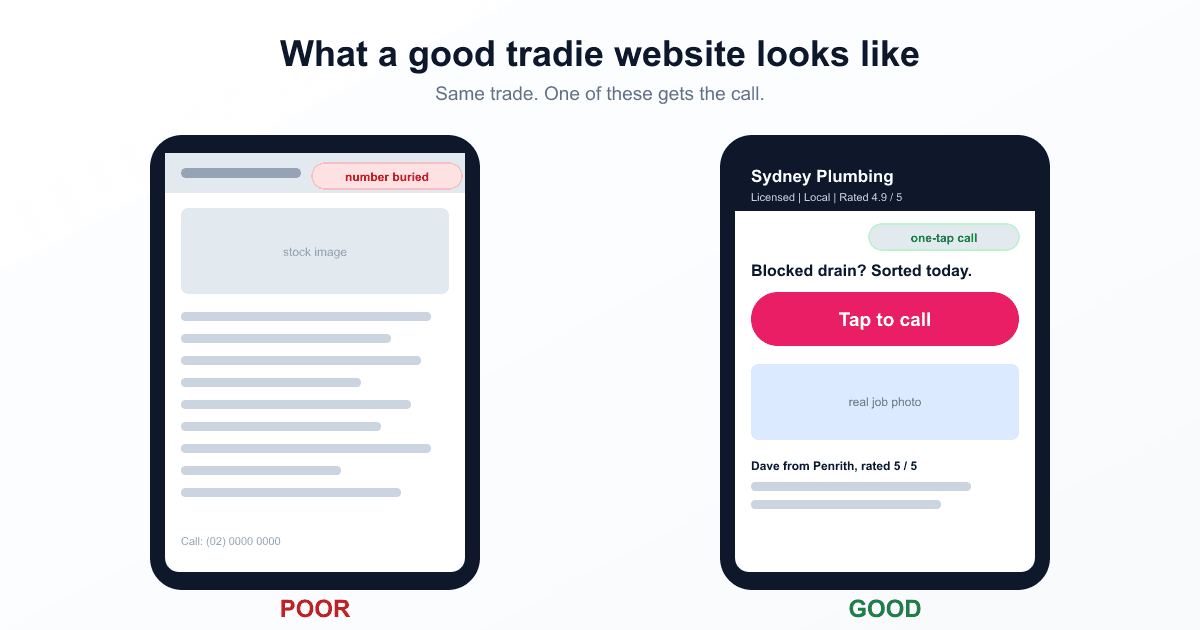
The single biggest fix on most tradie sites is the phone number. On a good site, a customer can call you in one tap, from the moment the page loads, without scrolling or hunting.
That means:
- A tap-to-call button above the fold on mobile, not a number typed in tiny grey text in the footer
- A sticky call bar that follows the customer down the page so the option to ring is always there
- The number set up as a real
tel:link, so one tap dials, no copying and pasting
People searching for a tradie are often mid-problem. Burst pipe, dead power point, blocked drain. They are not in the mood to fill out a form and wait. Make ringing you the easiest thing on the page.
Action: Add a tap-to-call button to the top of your homepage today, even if you change nothing else. It is the highest-value 10-minute fix on this list.
Is It Built Mobile-First?
Most of your customers will only ever see your site on a phone. A good tradie site is designed for that screen first, then made to work on a laptop, not the other way around.
Mobile-first means readable text without pinching, buttons big enough for a thumb, forms that work on a cracked screen in the sun, and images that do not push the call button off the screen. A desktop-first site that has been "made responsive" usually still feels clumsy on a phone, and clumsy loses calls.
This matters enough that it gets its own guide: why tradie websites need to be mobile first goes deep on phone speed, thumb reach, and Google's mobile-first ranking. For now, the test is simple: if your site is annoying to use one-handed on your own phone, it is annoying for every customer too.
Action: Use your site one-handed on your phone for two minutes. Anything that makes you sigh is costing you work.
Does It Build Trust in the First 5 Seconds?
Tradies get judged fast. A customer is letting a stranger into their home or business, so the site has to prove you are real, local, and good before they will ring.
A good tradie site shows, above the fold or close to it:
- Real job photos of your actual work, not stock images of someone else's tools (why stock kills conversions)
- Named reviews with suburbs ("Dave from Penrith"), not anonymous five-star blobs
- Your licence number and ABN, shown plainly so you look legitimate and compliant. Displaying your licence number is a legal requirement for licensed trades in most states
- Clear service area, so a customer knows in one glance that you cover their suburb
- Any guarantees, insurance, or callout terms stated up front
Trust is not a page called "About" that nobody reads. It is the proof you sprinkle across the whole site so the customer relaxes and rings. The same applies to how you reply: quoting from Gmail while your site looks premium undermines the first impression you just built.
Action: Put three real job photos and two named reviews on your homepage. Photos from your phone beat stock images every time.
Does It Put Your Google Reviews Front and Centre?
For a tradie, Google reviews are the strongest proof you have. A good site does not hide them on a testimonials page. It shows your real Google rating where customers can see it, and links straight to your Google Business Profile so they can check you out for themselves.
A good tradie site does three things with reviews:
- Shows live Google reviews on the page, pulled straight from Google with the star rating and recent comments, not testimonials you typed yourself. The Google logo and a real star count carry far more weight than a quote with no source.
- Puts the overall rating up high. "4.9 stars from 120 Google reviews" near the top is instant credibility, before the customer has read a word about your work.
- Links to your Google Business Profile, so customers can read every review, see your photos, and confirm you are a real local business. Keep your name, address, and phone the same on the site and the profile, because Google trusts businesses whose details match everywhere.
It also pays to make leaving a review easy. A simple "leave us a review" button that opens your Google review link gets more reviews in, and more reviews lift both trust and where you sit in the Google Maps results.
Getting and replying to reviews is a whole topic on its own. Our Google reviews guide for tradies covers how to ask, when to ask, and how to handle a bad one.
Action: Add your live Google rating and a link to your Google Business Profile to your homepage, and put a "leave a review" button where customers can tap it after a job.
Is There One Clear Action on Every Page?
A good page asks the customer to do one thing. Call, or request a quote. That is it.
Sites that offer ten options get zero. When every page has one obvious action, repeated at the top, the middle, and the bottom, the customer does not have to think. A short form (name, suburb, phone, what they need) beats a long one. Every extra field you add loses a few more people.
This is the part most "nice" sites get wrong. Award-worthy design with the contact form hidden on page four converts worse than an ugly page with a big call button.
Action: Pick one action per page. Remove the competing buttons. Make the one that is left impossible to miss.
Can Google and AI Search Actually Read It?
A good-looking site that Google cannot understand will not get found. And in 2026, it is not just Google. Tools like Google AI Overviews, ChatGPT search, and Perplexity now answer "best electrician near me" style questions directly, and they can only recommend businesses they can read clearly.
Being found means:
- A dedicated page for each service you offer, not one generic "Services" page
- Suburb pages for the areas you actually work in, so you rank for "plumber Penrith" not just your business name (see our suburb pages guide)
- Structured data behind the scenes so search engines and AI tools understand who you are, what you do, and where
- Clear FAQs and plain headings that AI tools can quote when someone asks about your trade
- Consistent name, address, and phone details that match your Google Business Profile
This is the engine room. It is invisible to the customer but it decides whether they ever see you at all. Our local SEO complete guide covers the full picture.
Action: Search your main service plus your suburb on your phone. If you are not on the first page or in the map pack, your site has a visibility problem, not just a design one.
Is It Fast?
Speed is a feature. A good tradie site targets a mobile PageSpeed score of 85 or higher and loads in a couple of seconds on 4G. Slow sites leak calls before the page even appears, and Google ranks them lower for it.
The usual culprits are huge unoptimised photos, cheap shared hosting, and bloated DIY templates stuffed with plugins. Good builds keep images light, run on quick hosting, and ship only what the page needs.
Action: Run your site through Google PageSpeed Insights. Under 70 on mobile? Assume you are losing visitors to the loading spinner.
Do You Own It, and Can You Edit It?
A good website is an asset you own, not something you rent and lose if you leave. You should own your domain and your site, and be able to change a phone number or add a photo without a fortnight's wait or a fresh invoice.
Watch for hostage setups: builders who keep the domain in their name, or charge a "monthly website fee" with no defined work behind it. Owning the asset, with simple edits available, is part of what good looks like.
Action: Check whose name your domain is registered in. If it is not yours, sort that out before you spend a cent on anything else.
Good vs Poor Tradie Website, Side by Side
Score your own site against this. Most sit somewhere in the middle, which is exactly where calls go missing.
| Feature | Poor tradie website | Good tradie website |
|---|---|---|
| Phone number | Tiny text in the footer | One-tap call button above the fold plus a sticky call bar |
| Mobile experience | Desktop site squeezed onto a phone | Designed for the phone first |
| Load speed (mobile) | Often 40 to 65, slow on 4G | 85 or higher, loads in seconds |
| Trust signals | Stock photos, anonymous reviews | Real job photos, named reviews with suburbs, licence and ABN shown |
| Google reviews | Hidden on a testimonials page, or quotes you wrote yourself | Live Google rating shown up top, with a link to your Google Business Profile |
| Action per page | Several competing options | One clear action: call or quote |
| Service pages | One generic "Services" page | A dedicated page per service |
| Suburb coverage | None | Suburb pages for the areas you work |
| Google and AI readability | Minimal, hard to crawl | Structured data, clean headings, FAQs |
| Ownership | Builder holds the domain | You own the domain and the site |
| Result | Looks fine, phone stays quiet | Looks sharp, phone keeps ringing |
How M4T Builds Hit These Marks
We build tradie sites around this exact list because it is what generates work. Mobile-first layout, one-tap calling, real photos and reviews, a page per service, suburb pages where you need them, structured data for Google and AI search, fast hosting, and a site you own and can edit. We pull the copy and photos from what you already have, so you spend a couple of hours on it, not a couple of weekends.
We build for calls, local Google ranking, and AI search, using your existing photos and details.
Want to know how the numbers stack up against doing it yourself or going to a generic agency? Read how much a tradie website should cost in 2026. For which path to pick (DIY vs freelancer vs agency vs tradie builder), see DIY vs agency for tradies. To see live sites broken down element by element, read our teardown of the best tradie website examples.
Explore our dedicated websites for tradies service packages, or see our pricing →
Want Us to Look at Yours and Tell You Straight?
The quickest way to know if your site measures up is to have someone who builds these every day take a look and tell you what is working and what is costing you calls.
- Book a quick call. Talk to a real person about your site and your trade. No pitch, no obligation, just a straight read on where you stand.
- Free website audit. We check mobile speed, conversion blockers, local ranking signals, and structured data, and send you a PDF within 24 hours.
Either way, you walk away knowing exactly what to fix first.
Frequently Asked Questions
What makes a tradie website good?
A good tradie website turns a local search into a phone call. That means it loads fast on a phone, lets a customer call in one tap, proves you do good work with real photos and named reviews, has one clear action per page, and is built so Google and AI search tools can find and recommend you. Looks matter least of all.
What should be on a tradie website homepage?
Your trade and service area in the headline, a one-tap call button above the fold, real job photos, two or three named reviews with suburbs, your licence number and ABN, the services you offer, and one clear way to get in touch. The customer should know who you are, what you do, and how to ring you within five seconds.
Should I show Google reviews on my website?
Yes. Google reviews are the strongest proof a tradie has, so a good site shows your live Google rating where customers see it straight away, not buried on a testimonials page. Pull them in from Google so the star rating and the Google logo show, and link to your Google Business Profile so customers can read the full list and check you are a real local business. It lifts trust and helps your Google Maps ranking. See our Google reviews guide for how to get more of them.
How many pages does a tradie website need?
It depends on your scope. A solo tradie in one area can start with a single sharp page. If you want Google to send work across several services or suburbs, you need a dedicated page for each service and suburb pages for the areas you cover. One generic "Services" page is rarely enough to rank. For a full page map and copy prompts by setup, see what to put on a tradie website.
What's the difference between a good and a poor tradie website?
A poor site looks fine but hides the phone number, loads slowly on a phone, uses stock photos, and offers no clear action, so the phone stays quiet. A good site is fast, mobile-first, full of real proof, asks for one clear action, and is built so search engines and AI tools can find it. One has a presence online, the other generates work.
Do I still need a website if I'm on hipages or Facebook?
Yes. hipages charges ongoing fees for leads you share with competitors. Facebook is rented space you do not control. Your own website generates enquiries that come only to you, with no per-lead cost once it ranks, and it is the asset that Google and AI search tools point people to. See our directories guide for the full comparison.
How do I know if my current website is any good?
Open it on your phone and run the quick test: can you tap to call in one move, does it load in a couple of seconds, do you see real photos and named reviews, and is there one obvious action? Then search your main service plus your suburb and see if you show up. If it fails on speed, calling, trust, or visibility, it is costing you work.
How fast should a tradie website load?
Aim for a Google PageSpeed score of 85 or higher on mobile and a load time of a couple of seconds on 4G. Around half of visitors leave a mobile page that takes longer than three seconds, so speed directly affects how many calls you get.
References:
- [1] 1stPage, How to Rank for Near Me Searches in Australia (2025), mobile share of local search
- [2] Think with Google, New Industry Benchmarks for Mobile Page Speed, 2017
- [3] BrightLocal, Local Consumer Review Survey 2020, US consumers
- [4] hipages, The On-Demand Tradie Economy, EY Sweeney survey of Australian consumers, June to July 2018
Published by Made 4 Tradies, built by online experts who understand tradies. Serving Sydney, the Central Coast, Newcastle, and the Hunter.
Talk To A Real Person
Want us to look at your site and tell you straight?
Book a quick call and we'll tell you what's working, what's costing you calls, and what to fix first. No pitch, no obligation.
A straight read on your website from people who build them for tradies every day.
Book a quick call →Prefer it in writing? Free website audit →